Why we want to improve

2.1 Where are we now (incomplete text)
Where are we now
Customer interactions
01
Over 75% of customer interactions are received via digital means, including automated online forms , voice-activated application for enabled devices, personalised customer portals, Councillor Portal, Report It app, automated telephony and customer facing chatbot
Our digital front door
02
Our digital front door is integrated with many of our back office systems, providing a seamless experience for customers and timely responses.
Customer satisfaction
03
Award winning website, with a high customer satisfaction rate with digital services.
Secure
data
04
Established the necessary safeguards to protect and secure our data as we explore how Artificial Intelligence can support what we do, streamline processes and provide more personalised experiences.
Digital foundation
05
A robust digital foundation to propel our ongoing digital transformation, encompassing a variety of established capabilities, a network of digital advocates championing change and new technologies, and a digital learning platform to ensure we possess the necessary skills.
Where are we now
Where are we now
This strategy is not just about adopting new technologies but about creating an enabling environment where innovation can thrive. It is about positioning our digital strategy as an enabler, empowering all council services to operate more effectively, efficiently, and innovatively.

Customer interactions
Over 75% of customer interactions are received via digital means, including automated online forms , voice-activated application for enabled devices, personalised customer portals, Councillor Portal, Report It app, automated telephony and customer facing chatbot

Our digital front door
Our digital front door is integrated with many of our back office systems, providing a seamless experience for customers and timely responses.

Customer satisfaction
Award winning website, with a high customer satisfaction rate with digital services.
Customer satisfaction
Award winning website, with a high customer satisfaction rate with digital services.
Customer satisfaction
Award winning website, with a high customer satisfaction rate with digital services.

Delivering seamless digital customer experiences
Over 75% of customer interactions now happen through digital channels, including online forms, voice-activated apps, personalised portals, automated telephony, and chatbots. Our award-winning website consistently receives high satisfaction ratings, and our integrated digital front door connects directly with back-office systems to ensure smooth, timely service delivery.

Digitising internal processes
We’re also changing how we work, using Power Apps, online forms, and automated workflows to support processes. These tools help staff work more smartly, reduces manual tasks, and improves service delivery behind the scenes.

Secure data
Established the necessary safeguards to protect and secure our data as we explore how Artificial Intelligence can support what we do, streamline processes and provide more personalised experiences.

Digital foundation
A robust digital foundation to propel our ongoing digital transformation, encompassing a variety of established capabilities, a network of digital advocates championing change and new technologies, and a digital learning platform to ensure we possess the necessary skills.

Customer interactions
Over 75% of customer interactions are received via digital means, including automated online forms, voice-activated application for enabled devices, personalised customer portals, Councillor Portal, Report It app, automated telephony and customer facing chatbot. Our digital front door is integrated with many of our back office systems, providing a seamless experience for customers and timely responses. Award-winning website, with a high customer satisfaction rate with digital services.
Delivering seamless digital customer experiences
Over 75% of customer interactions now happen through digital channels, including online forms, voice-activated apps, personalised portals, automated telephony, and chatbots. Our award-winning website consistently receives high satisfaction ratings, and our integrated digital front door connects directly with back-office systems to ensure smooth, timely service delivery.
Digitising internal processes
We’re also changing how we work, using Power Apps, online forms, and automated workflows to support processes. These tools help staff work more smartly, reduces manual tasks, and improves service delivery behind the scenes.
Secure data
Established the necessary safeguards to protect and secure our data as we explore how Artificial Intelligence can support what we do, streamline processes and provide more personalised experiences.
Digital foundation
A robust digital foundation to propel our ongoing digital transformation, encompassing a variety of established capabilities, a network of digital advocates championing change and new technologies, and a digital learning platform to ensure we possess the necessary skills.
Why we want to improve
The world is changing fast and digital technology is transforming how we live, work, and connect. We’re committed to keeping pace – offering modern, accessible services built on strong, future-ready digital foundations. Recent years have shown how vital digital inclusion and resilience are, whether delivering services remotely, supporting vulnerable residents or driving local growth.
Where are we now
Cheshire West and Chester has made significant progress on its digital journey. We’ve built strong foundations and achieved key milestones, so we’re not starting from scratch. Now, we’re ready to take the next step.

Customer interactions
Over 75% of customer interactions are received via digital means, including automated online forms, voice-activated application for enabled devices, personalised customer portals, Councillor Portal, Report It app, automated telephony and customer facing chatbot. Our digital front door is integrated with many of our back office systems, providing a seamless experience for customers and timely responses. Award-winning website, with a high customer satisfaction rate with digital services.

Delivering seamless digital customer experiences
Over 75% of customer interactions now happen through digital channels, including online forms, voice-activated apps, personalised portals, automated telephony, and chatbots. Our award-winning website consistently receives high satisfaction ratings, and our integrated digital front door connects directly with back-office systems to ensure smooth, timely service delivery.
Digitising internal processes
We’re also changing how we work, using Power Apps, online forms, and automated workflows to support processes. These tools help staff work more smartly, reduces manual tasks, and improves service delivery behind the scenes.
Delivering seamless digital customer experiences
Over 75% of customer interactions now happen through digital channels, including online forms, voice-activated apps, personalised portals, automated telephony, and chatbots. Our award-winning website consistently receives high satisfaction ratings, and our integrated digital front door connects directly with back-office systems to ensure smooth, timely service delivery.

Digitising internal processes
We’re also changing how we work, using Power Apps, online forms, and automated workflows to support processes. These tools help staff work more smartly, reduces manual tasks, and improves service delivery behind the scenes.

Secure data
We have established the necessary safeguards to protect and secure our data as we explore how Artificial Intelligence can support what we do, streamline processes and provide more personalised experiences.

Digital foundation
A robust digital foundation is in place, to propel our ongoing digital transformation, encompassing a variety of established capabilities, a network of digital advocates championing change and new technologies, and a digital learning platform to ensure we possess the necessary skills.
Where are we now
Customer interactions
Over 75% of customer interactions are received via digital means, including automated online forms, voice-activated application for enabled devices, personalised customer portals, Councillor Portal, Report It app, automated telephony and customer facing chatbot.
Our digital front door
Our digital front door is integrated with many of our back office systems, providing a seamless experience for customers and timely responses.
Customer satisfaction
Award-winning website, with a high customer satisfaction rate with digital services.

Secure data
We have established the necessary safeguards to protect and secure our data as we explore how Artificial Intelligence can support what we do, streamline processes and provide more personalised experiences.
Digital foundation
A robust digital foundation is in place, to propel our ongoing digital transformation, encompassing a variety of established capabilities, a network of digital advocates championing change and new technologies, and a digital learning platform to ensure we possess the necessary skills.

How can we tell if we are getting it right
Our next step is to build on the progress we’ve made, scale up what works, and deliver greater impact for residents, businesses, and communities. Over the next three years, success means creating digital services that are simple, inclusive, and trusted, supported by strong foundations and driven by data and innovation.
Here's what that looks like in practice:
01
Supporting delivery of the Borough Plan:
Our Digital Ambition is key to the success of the Borough Plan, enabling council services to be more effective, efficient and innovative. Our comprehensive digital approach helps the council achieve its goals and provide exceptional service to its customers.
02
Supporting our customers, both internally and externally:
Our Digital Ambition aims the enhance experiences for both internal and external customers. Internally, it empowers staff with better tools and resources, while externally, it makes services more accessible and user friendly.
03
Enabling council services:
Creating inclusive and easy to use digital experiences, supports the council’s goals of simplifying the complex and making services more responsive, integrated and insight driven. Our Digital Ambition also focuses on sustainability by using digital innovation to provide sustainable living, optimise resources and reduce waste.
04
Driving out productivity and value through ICT and digital improvements:
Collectively the automation of tasks, improved communication, enhanced customer experience, optimisation of resources and the fostering of innovation, drives out productivity and value by making the council more efficient, responsive and customer focused.
Simple, inclusive services for everyone
Residents and staff can complete tasks online in minutes, with clear support for those who need extra help.
Decisions that improve lives
Data and feedback drive continuous improvements, so services adapt as needs evolve.
Fast, flexible delivery
New features and fixes roll out quickly, keeping services relevant
and resilient.
Strong, secure foundations
Future-ready infrastructure and robust data protection give people confidence and enable better outcomes.
A thriving digital economy
Businesses grow, investment flows in, and innovation benefits the
whole community.
Together with colleagues and partners, we will create a digital borough that works for everyone – building trust, driving growth, and making life simpler and better for all.
Simple, inclusive services for everyone
Residents and staff can complete tasks online in minutes, with clear support for those who need extra help.
Decisions that
improve lives
Data and feedback drive continuous improvements, so services adapt as needs evolve.
Fast, flexible delivery
New features and fixes roll out quickly, keeping services relevant and resilient.
Strong, secure foundations
Future-ready infrastructure and robust data protection give people confidence and enable better outcomes.
A thriving digital economy
Businesses grow, investment flows in, and innovation benefits the whole community.
Together with colleagues and partners, we will create a digital borough that works for everyone – building trust, driving growth, and making life simpler and better for all.
Digital opportunities through ICT infrastructure modernisation
The transformative potential of upgrading our ICT environment
Upgrading our ICT systems isn’t just about getting newer technology, it’s about using that technology to make the Council work better. By modernising our infrastructure, we can improve how we operate, offer better services to residents, and create a more connected and innovative community.
Modern systems are more reliable and efficient. They reduce downtime, which means services are available when people need them. They also work faster, helping staff get more done and improving the experience for everyone who uses our services.
We can also boost productivity by automating repetitive tasks. Tools like process automation helps us streamline workflows, so staff spend less time on manual process and more time on meaningful work that drives improvement.
Security is a top priority. With stronger protections in place, we can better defend against cyber threats and keep sensitive data safe. Modern ICT systems are built to be resilient. That means if something does go wrong, we’ll be able to recover quickly and keep services running smoothly.
Modern ICT systems are also scalable and flexible. As needs changes, we can easily adjust our systems – adding more capacity or scaling back. As customer expectations evolve, we can update or services to match, making sure they stay relevant and effective.
Investing in modern ICT also saves money in the long term. New systems are more energy-efficient and cost less to maintain. Moving to cloud-based services reduces the need for expensive hardware and helps us manage costs more sustainably, as we only pay for what we use.
Reliability and efficiency
Modern systems are more reliable and efficient. They reduce downtime, which means services are available when people need them.
They also work faster, helping staff get more done and improving the experience for everyone who uses our services.
Enhanced productivity
We can also boost productivity by automating repetitive tasks.
Tools like process automation helps us streamline workflows, so staff spend less time on manual process and more time on meaningful work that drives improvement.
Security and resilience
Security is a top priority. With stronger protections in place, we can better defend against cyber threats and keep sensitive data safe.
Modern ICT systems are built to be resilient. That means if something does go wrong, we’ll be able to recover quickly and keep services running smoothly.
Scalable and flexible
Modern ICT systems are also scalable and flexible. As needs change, we can easily adjust our systems – adding more capacity or scaling back. As customer expectations evolve, we can update our services to match, making sure they stay relevant and effective.
Cost effective and efficient
Investing in modern ICT also saves money in the long term. New systems are more energy-efficient and cost less to maintain. Moving to cloud-based services reduces the need for expensive hardware and helps us manage costs more sustainably, as we only pay for what we use.
The building blocks of our digital service
To deliver our digital ambition, we are assembling the key building blocks of our digital service, each one an essential piece of the puzzle.


The building blocks of our digital service
To deliver our digital ambition, we are assembling the key building blocks of our digital service, each one an essential piece of the puzzle.
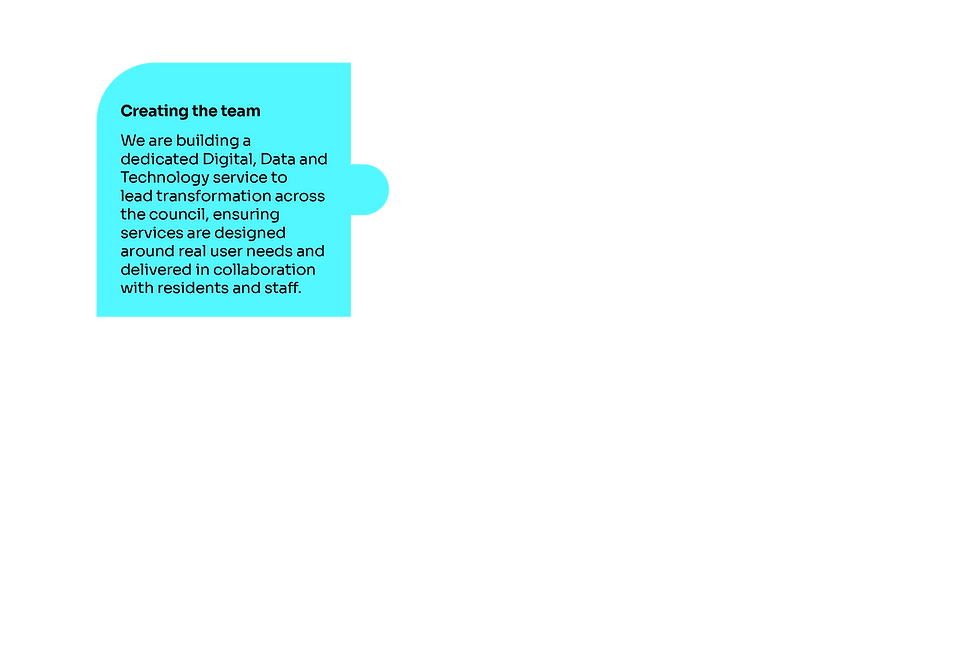
We are building a dedicated Digital, Data and Technology service to lead transformation across the council, ensuring services are designed around real user needs and delivered in collaboration with residents
and staff.We are upgrading our ICT systems and moving to cloud-based platforms like Azure, Foundry, and Fabric. This creates a more reliable, scalable, and futureproof foundation for digital services.
We are enhancing data governance and introducing tools like Power BI to turn data into clear, actionable insights — enabling smarter, evidence-based decisions.
We are following expert guidance to manage data securely and responsibly, ensuring transparency, compliance, and trust in all our
digital services.
We are encouraging innovation, collaboration and continuous
learning, to equip staff with the digital and data skills to adapt to
change with confidence.
We are designing digital services that are intuitive, accessible and effective – supporting staff, residents and businesses whilst enabling
innovation and growth across the borough.
Digital opportunities through ICT infrastructure modernisation
Opportunities from modernising our ICT Infrastructure
Our programme to modernise ICT infrastructure presents various opportunities that support the council’s Digital Ambition and transform Cheshire West and Chester into a technology-driven haven.
These opportunities are not limited to internal operational improvements but extend to enhancing community engagement and service delivery.
Power automate environment
The integration of Power Automate streamlines workflows, reduces manual tasks, and improves efficiency. Automated processes ensure consistency and accuracy, freeing up staff to focus on strategic initiatives and customer-centric activities.
Power BI enviornment
The adoption of Power BI fosters a data-driven culture within the council. Enhanced data visualisation and analytics capabilities enable informed decision-making, empowering staff to derive insights and drive performance improvements.
Intelligent-I data review recommendations
Implementing Itelligent-I data review recommendations enhances data governance and security. These recommendations ensure that data is managed efficiently, securely, and in compliance with regulations, fostering trust and reliability.
Fabric, Foundary and Azure environments
Leveraging Fabric, Foundry, and Azure environments introduces robust, scalable, and flexible solutions. These environments support the council’s Digital Ambition by providing advanced technological capabilities that enhance service delivery and operational efficiency.
Saas & cloud hosting
The shift to SaaS and cloud hosting reduces the reliance on expensive on-premises infrastructure. This transition offers cost savings, scalability, and flexibility, ensuring that services remain responsive to changing needs and demands.
The modernisation of our ICT infrastructure is a pivotal step towards realising our Digital Ambition. By embracing advanced technologies, we unlock opportunities that enhance reliability, efficiency, security, resilience, scalability, and cost-effectiveness.
These digital opportunities not only improve council operations but also drive innovation, engagement, and service excellence, transforming Cheshire West and Chester into a thriving, technology-enabled community.
Opportunities from modernising our ICT Infrastructure
Our programme to modernise ICT infrastructure presents various opportunities that support the council’s Digital Ambition and transform Cheshire West and Chester into a technology-driven haven.
These opportunities are not limited to internal operational improvements but extend to enhancing community engagement and service delivery.
The integration of Power Automate streamlines workflows, reduces manual tasks, and improves efficiency. Automated processes ensure consistency and accuracy, freeing up staff to focus on strategic initiatives and customer-centric activities.
The adoption of Power BI fosters a data-driven culture within the council. Enhanced data visualisation and analytics capabilities enable informed decision-making, empowering staff to derive insights and drive performance improvements.
Implementing Itelligent-I data review recommendations enhances data governance and security. These recommendations ensure that data is managed efficiently, securely, and in compliance with regulations, fostering trust and reliability.
Leveraging Fabric, Foundry, and Azure environments introduces robust, scalable, and flexible solutions. These environments support the council’s Digital Ambition by providing advanced technological capabilities that enhance service delivery and operational efficiency.
The shift to SaaS and cloud hosting reduces the reliance on expensive on-premises infrastructure. This transition offers cost savings, scalability, and flexibility, ensuring that services remain responsive to changing needs and demands.
The modernisation of our ICT infrastructure is a pivotal step towards realising our Digital Ambition. By embracing advanced technologies, we unlock opportunities that enhance reliability, efficiency, security, resilience, scalability, and cost-effectiveness.
These digital opportunities not only improve council operations but also drive innovation, engagement, and service excellence, transforming Cheshire West and Chester into a thriving, technology-enabled community.
Power automate environment
The integration of Power Automate streamlines workflows, reduces manual tasks, and improves efficiency. Automated processes ensure consistency and accuracy, freeing up staff to focus on strategic initiatives and customer-centric activities.
Power BI enviornment
The adoption of Power BI fosters a data-driven culture within the council. Enhanced data visualisation and analytics capabilities enable informed decision-making, empowering staff to derive insights and drive performance improvements.
Intelligent-I data review recommendations
Implementing Itelligent-I data review recommendations enhances data governance and security. These recommendations ensure that data is managed efficiently, securely, and in compliance with regulations, fostering trust and reliability.
Fabric, Foundary and Azure environments
Leveraging Fabric, Foundry, and Azure environments introduces robust, scalable, and flexible solutions. These environments support the council’s Digital Ambition by providing advanced technological capabilities that enhance service delivery and operational efficiency.
Saas / Cloud hosting
The shift to SaaS and cloud hosting reduces the reliance on expensive on-premises infrastructure. This transition offers cost savings, scalability, and flexibility, ensuring that services remain responsive to changing needs and demands.
The modernisation of our ICT infrastructure is a pivotal step towards realising our Digital Ambition. By embracing advanced technologies, we unlock opportunities that enhance reliability, efficiency, security, resilience, scalability, and cost-effectiveness.
These digital opportunities not only improve council operations but also drive innovation, engagement, and service excellence, transforming Cheshire West and Chester into a thriving, technology-enabled community.
Infrastructure roadmap
Intro paragraph needed for this small section
Establishing the Digital, Data and Technology (DDAT) team to lead digital transformation initiatives.
Modernising ICT infrastructure to enhance reliability, efficiency, security, resilience, scalability, and cost-effectiveness.
Transitioning to SaaS and cloud hosting to reduce reliance on expensive on-premises infrastructure.
Embedding digital capabilities through a comprehensive and structured digital methodology.
Adopting Power BI to enhance data visualisation and analytics capabilities for informed decision-making.
Enhancing data governance and security through the implementation of Intelligent-I data review recommendations.
Introducing robust, scalable, and flexible solutions with Fabric, Foundry, and Azure environments.
Achieving the council's Digital Ambition by enhancing service delivery, operational efficiency, and driving innovation.

Our digital methodology to embed this change
Delivering modern, efficient, and customer-focused services requires more than adopting new technologies, it requires a clear approach to applying them effectively. Our digital capabilities, from automation and data insights to AI and user-friendly platforms, provide the tools to innovate and improve how the council operates.
To ensure these capabilities deliver real value, we embed them through a structured methodology that identifies opportunities, tests solutions, and measures impact before full implementation. This approach keeps us agile, responsive and focused on outcomes that
matter for residents, businesses, and staff.
Our digital capabilities
Our range of digital capabilities enables us to leverage digital innovation to enhance the Council’s services.
Power Platform suite
The Power Platform suite supports the creation of applications, workflow and data insights.
Robotic Process Automation (RPA)
Automates repetitive, rule-based tasks like data entry and system updates – delivering consistent, error-free processes each time that can be easily scaled to handle high volumes, working 24/7 to keep services running smoothly.
Digital forms
Digital forms allow for data to be accurately captured, can improve accessibility and increase processing speed.
Portals
Our range of portal platforms provide a centralised access point for services and information, enhancing user experience and offering a seamless integrated interface with back-office systems.
Digital communication platform
Multi-channel communication and engagement capability for residents, businesses and staff.
Artificial Intelligence and Gen-AI
Artificial Intelligence and Gen-AI has the potential to transform service delivery, introducing new insights and driving out productivity and value through its application.
Supplier-led solutions
Collaborating with supplier-led solutions enables the leveraging of innovative solutions and expertise.
Our methodology
Our methodology to embed digital capabilities outlines a structured approach to identify, review, and implement digital solutions.
By identifying a process and its challenges, areas for improvement are identified. A range of digital capabilities can then be piloted to see how they perform in real-world scenarios. Based on observations and tests we can adjust to ensure the resulting solutions are effective and meet the needs of users.
After iterating the impact of the solutions, they are assessed to confirm they realise the expected benefits e.g. the reduction in time taken to assess an application. Once validated, deployment with training and support embeds the digital capability leading to improved effectiveness, productivity and customer satisfaction.
Our methodology
Our methodology to embed digital capabilities outlines a structured approach to identify, review, and implement digital solutions.
By identifying a process and its challenges, areas for improvement are identified. A range of digital capabilities can then be piloted to see how they perform in real-world scenarios. Based on observations and tests we can adjust to ensure the resulting solutions are effective and meet the needs of users.
After iterating the impact of the solutions, they are assessed to confirm they realise the expected benefits e.g. the reduction in time taken to assess an application. Once validated, deployment with training and support embeds the digital capability leading to improved effectiveness, productivity and customer satisfaction.
Step one
Indentifying the Use Case
-
Business need
-
Pain points
-
Spend
Step two
Initial Assessment
-
SME overview
-
Clearly defining the problem
Step three
Process & Technical Analysis
-
Observations
-
Process mapping
-
Data collection
-
Ai / automation opportunities
Step four
Benefits Assessment
-
Time savings
-
Cost / reduction / avoidance
-
Other benefits
Step five
PoC Approval & Implementation
-
Director approval
-
Business engagement
-
Pilot implementation
-
Full scale depolyment

Step 1
Identifying the Use Case
-
Business needs
-
Pain points
-
Spend

Step 2
Initial assessment
-
SME overview
-
Clearly defining the problem

Step 3
Process & techincal analysis
-
SME overview
-
Clearly defining the problem

Step 4
Benefits assessment
-
Time savings
-
Cost reduction / avoidance
-
Other benefits

Step 5
PoC approval & implementation
-
Director approval
-
Business engagement
-
Pilot implementation
-
Full scale deployment
Step 1
Identifying the Use Case
Before we start any digital initiative, we need to understand why it’s needed and what problem it solves. This step ensures we focus on the right opportunities.
What are the goals or challenges are we addressing? For example, improving efficiency, reducing costs or enhancing customer experience.
Where are the current frustrations or inefficiencies? These could be manual processes, delays or lack of data visibility.
What is the current cost of the process or solution? Understanding costs helps us measure potential savings and justify investment.
Step 2
Initial assessment
Once we have a use case, we carry out a quick review to confirm it’s worth exploring further.
Subject Matter Experts (SMEs) share how things work today.
A clear, simple statement of what needs fixing. This avoids confusion later.

Step 3
Process and techincal analysis
Here we dig deeper into the details to make sure the solution is practical and fits with our technology landscape.
SMEs help map out the current process step-by-step and highlight technical constraints.
We refine the problem statement based on what we learn, ensuring it’s accurate and actionable.
Step 4
Benefits assessment
We evaluate the potential impact of the solution to make sure it delivers real value.
How much faster could the new approach be compared to the old way of working?
Will it reduce costs or prevent future expenses?
These could include improved safety, better data quality, enhanced customer satisfaction or environmental benefits.
Step 5
Proof of Concept Approval and Implementation
Finally, we move from idea to reality, starting small and then scaling up.
We make sure the proposal meets compliance, security and business standards.
We involve the right teams early to ensure buy-in and smooth adoption.
We test the solution on a small scale to prove it works before investing further.
If the pilot is successful, we roll out the solution across the business.
Step 3
Process and techincal analysis
Here we dig deeper into the details to make sure the solution is practical and fits with our technology landscape.
SMEs help map out the current process step-by-step and highlight technical constraints.
We refine the problem statement based on what we learn, ensuring it’s accurate and actionable.

Step 1
Identifying the Use Case
Before we start any digital initiative, we need to understand why it’s needed and what problem it solves. This step ensures we focus on the right opportunities.

Step 2
Initial assessment
Once we have a use case, we carry out a quick review to confirm it’s worth exploring further.
Step 3
Process and techincal analysis
Here we dig deeper into the details to make sure the solution is practical and fits with our technology landscape.
What are the goals or challenges are we addressing? For example, improving efficiency, reducing costs or enhancing customer experience.
Where are the current frustrations or inefficiencies? These could be manual processes, delays or lack of data visibility.
What is the current cost of the process or solution? Understanding costs helps us measure potential savings and justify investment.
Subject Matter Experts (SMEs) share how things work today.
A clear, simple statement of what needs fixing. This avoids confusion later.
SMEs help map out the current process step-by-step and highlight technical constraints.
We refine the problem statement based on what we learn, ensuring it’s accurate and actionable.
Step 4
Benefits assessment
We evaluate the potential impact of the solution to make sure it delivers real value.
Step 5
PoC approval & implementation
Finally, we move from idea to reality, starting small and then scaling up.
How much faster could the new approach be compared to the old way of working?
Will it reduce costs or prevent future expenses?
These could include improved safety, better data quality, enhanced customer satisfaction or environmental benefits.
We make sure the proposal meets compliance, security and business standards.
We involve the right teams early to ensure buy-in and smooth adoption.
We test the solution on a small scale to prove it works before investing further.
If the pilot is successful, we roll out the solution across the business.
Methodology example case study


Digital form
A customer submits a simple online request.
Why it helps:
Fewer phone calls and
re-keying, better data quality from the start.

Generative AI
AI creates a concise case summary from the request and related information.
Why it helps:
Staff get up to speed quickly, with a single, consistent view of the case.

Notes in any format (handwritten, typed, voice note)
A practitioner meets the customer and captures notes in their preferred way.
Why it helps:
Inclusive and flexible – no need to
change how practitioners work.
Generative AI
(assessment drafting)
AI turns meeting notes into a clear, structured assessment document.
Why it helps:
Reduces writing time, improves consistency and readability.

Validate
Anticipated benefits include:
-
Quicker response times
-
Improved customer experience
-
Enhanced employee satisfaction
-
Reduced backlog
-
Cost reduction / avoidance
Why it helps: Ensures the solution delivers measurable improvements before scaling.


Robotic process automation (RPA)
Key assessment data is automatically entered into the case management system.
Why it helps:
Removes manual data entry and errors, speeding up case progression.

Share digitally, print and mail if needed
The assessment is shared with the customer through their preferred channel.
Why it helps:
Accessible for everyone; digital first, with print where necessary.
Digital form
A customer submits a simple online request.
Why it helps:
Fewer phone calls and
re-keying, better data quality from the start.
Generative AI
AI creates a concise case summary from the request and related information.
Why it helps:
Staff get up to speed quickly, with a single, consistent view of the case.
Notes in any format (handwritten, typed, voice note)
A practitioner meets the customer and captures notes in their preferred way.
Why it helps:
Inclusive and flexible – no need to change how practitioners work.

Generative AI
(assessment drafting)
AI turns meeting notes into a clear, structured assessment document.
Why it helps:
Reduces writing time, improves consistency and readability.

Digital form
A customer submits a simple online request.
Why it helps: Fewer phone calls and re-keying, better data quality from the start.
Generative AI
AI creates a concise case summary from the request and related information.
Why it helps: Staff get up to speed quickly, with a single, consistent view of the case.
Notes in any format (handwritten, typed, voice note)
A practitioner meets the customer and captures notes in their preferred way.
Why it helps: Inclusive and flexible – no need to change how practitioners work.
Generative AI
(assessment drafting)
AI turns meeting notes into a clear, structured assessment document.
Why it helps: Reduces writing time, improves consistency and readability.
Digital form
Customer contacts the council requesting social care support.
Generative AI
Chris familiarises himself with the request, generating a case summary from a variety of sources.
Handwritten, typed, voice note
Chris meets with customer to understand their needs, taking notes in his preferred format.
Generative AI
Chris compiles meeting outputs to produce a formal assessment document.
Digital, print and mail
Chris then shares assessment with customer.

Robotic process automation
Chris then inputs key assessment data into a case management system.
Validate
Anticipated benefits include:
-
Quicker response. times
-
Improved customer experience
-
Enhanced employee satisfaction
-
Reduced backlog
-
Cost avoidance
Putting the methodology into practice
At Cheshire West and Chester, we’re committed to turning digital ambition into tangible outcomes.
This section showcases real-world examples where digital and technology initiatives could support service transformation, improve resident experiences, and enhance operational resilience. These use cases reflect our collaborative approach to solving local challenges with practical, people-focused solutions.

By identifying a process and its challenges, areas for improvement are identified. A range of digital capabilities can then be piloted to see how they perform in real-world scenarios. Based on observations and tests we can adjust to ensure the resulting solutions are effective and meets the needs of users. After iterating the impact of the solutions, they are assessed to confirm they realise the expected benefits e.g. the reduction in time taken to assess an application. Once validated, deployment with training and support embeds the digital capability leading to improved effectiveness, productivity and customer satisfaction.
How our methodology makes a difference
Chris is a council officer who undertakes social care assessments, here’s how our methodology could make a difference.

By identifying a process and its challenges, areas for improvement are identified. A range of digital capabilities can then be piloted to see how they perform in real-world scenarios. Based on observations and tests we can adjust to ensure the resulting solutions are effective and meets the needs of users.
After iterating the impact of the solutions, they are assessed to confirm they realise the expected benefits e.g. the reduction in time taken to assess an application.
Once validated, deployment with training and support embeds the digital capability leading to improved effectiveness, productivity and customer satisfaction.
01
User-centric design
Focusing on the needs and preferences of our residents and communities, we can ensure that our digital services are not only accessible but also efficient, effective and enjoyable to use. This approach will enable us to foster trust and engagement, making residents feel valued and heard.
02
Data-driven decision making
Informed decision solving ensuring we are making decisions based on evidence rather than assumptions and/or intuition.
-
Understand needs: using data we can identify trends, forecast demand ensuring we can allocate resources where it will be used more efficiently and effectively.
-
Proactive problem solving: identify and address problems early.
-
Cost effective: avoid wasteful spending by investing in effective services/processes.
03
Outcome focussed
This principle emphasises the importance of defining clear goals and objectives that the strategy aims to achieve. By focusing on outcomes, Cheshire West and Chester can ensure that our digital initiatives are aligned with the overall business objectives and deliver measurable results.
04
Agility and flexibility
Embrace an agile approach to quickly adapt to changes in the market and technology. This involves iterative development, continuous improvement, and the ability to pivot when necessary.
05
Value for money
We will focus on delivering cost effective solutions that benefit our residents, customers and services alike:
-
Ensuring resilience.
-
Cost effective.
-
Return on Investment.
-
Monitor performance.
Our roadmap
-
Embed design principles
-
Aligned Digital and Data Strategies
-
Build upon existing digital capabilities
-
Develop assessment based approach
-
Develop Data Platform
-
Modernise Cheshire West’s ICT infrastructure
-
-
Embed Gen-AI capabilities
-
Continue application rationalisation and move towards cloud
-
-
Continuous improvement and iteration
-
06
Contact Us
Ready to Partner with Us?
Contact us today.